

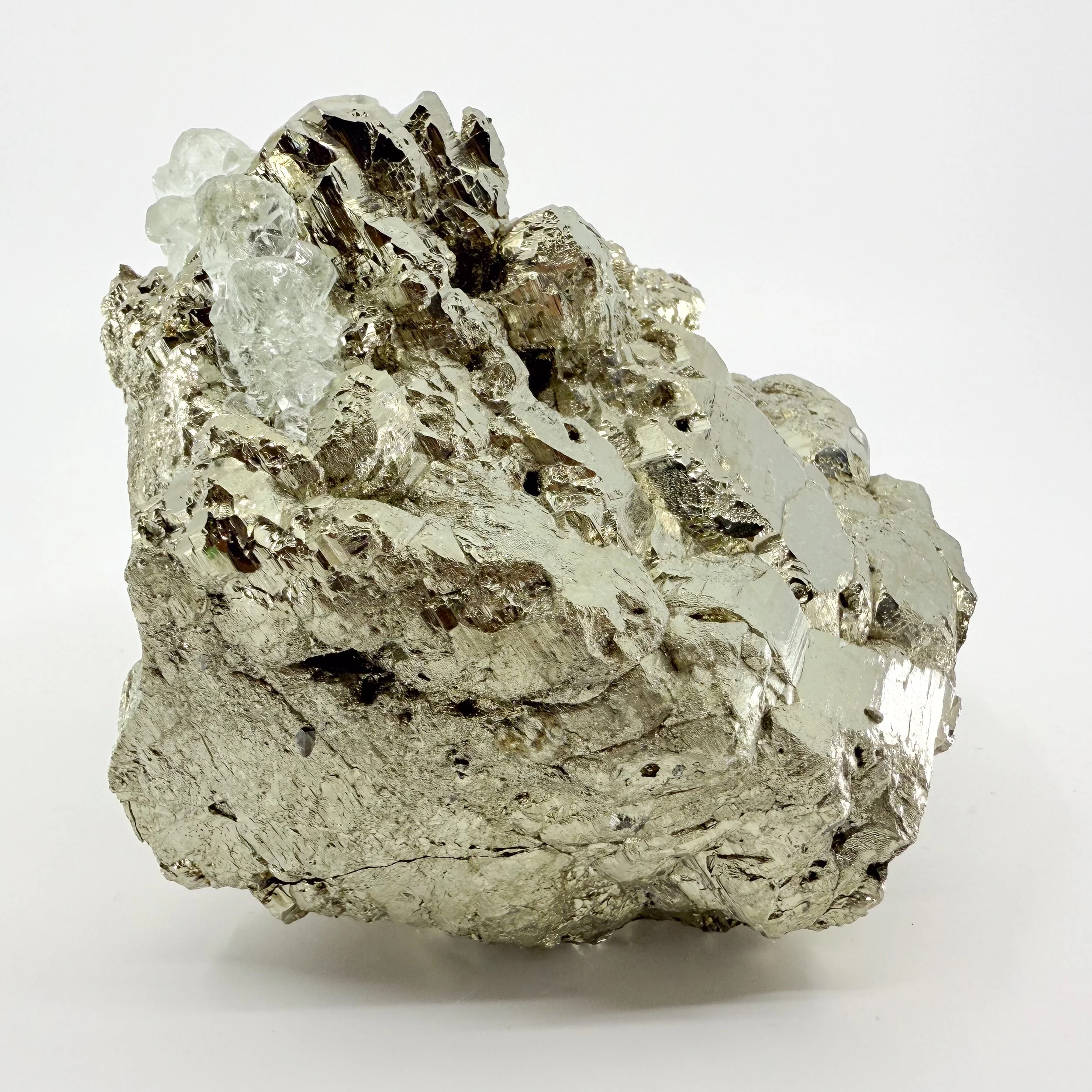

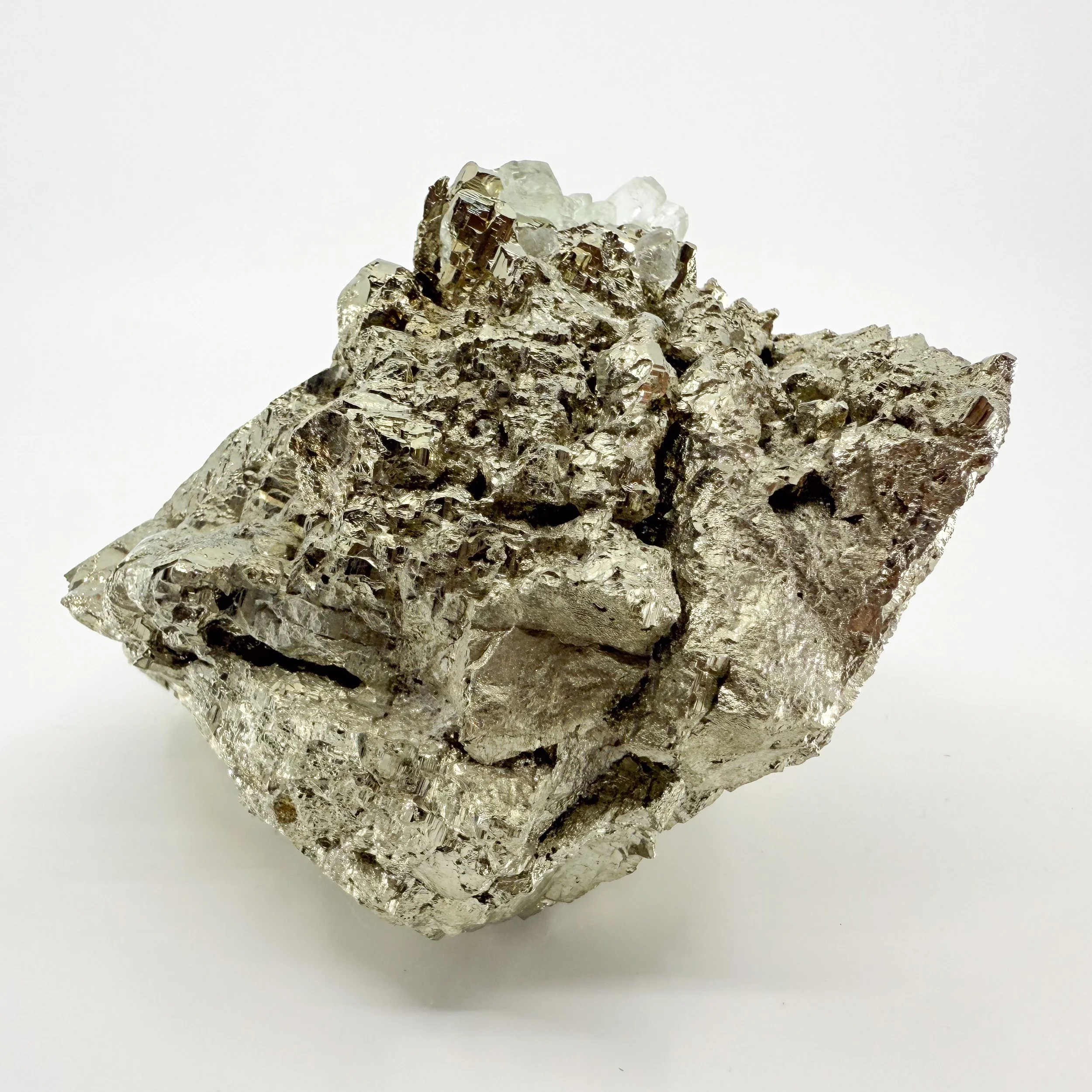
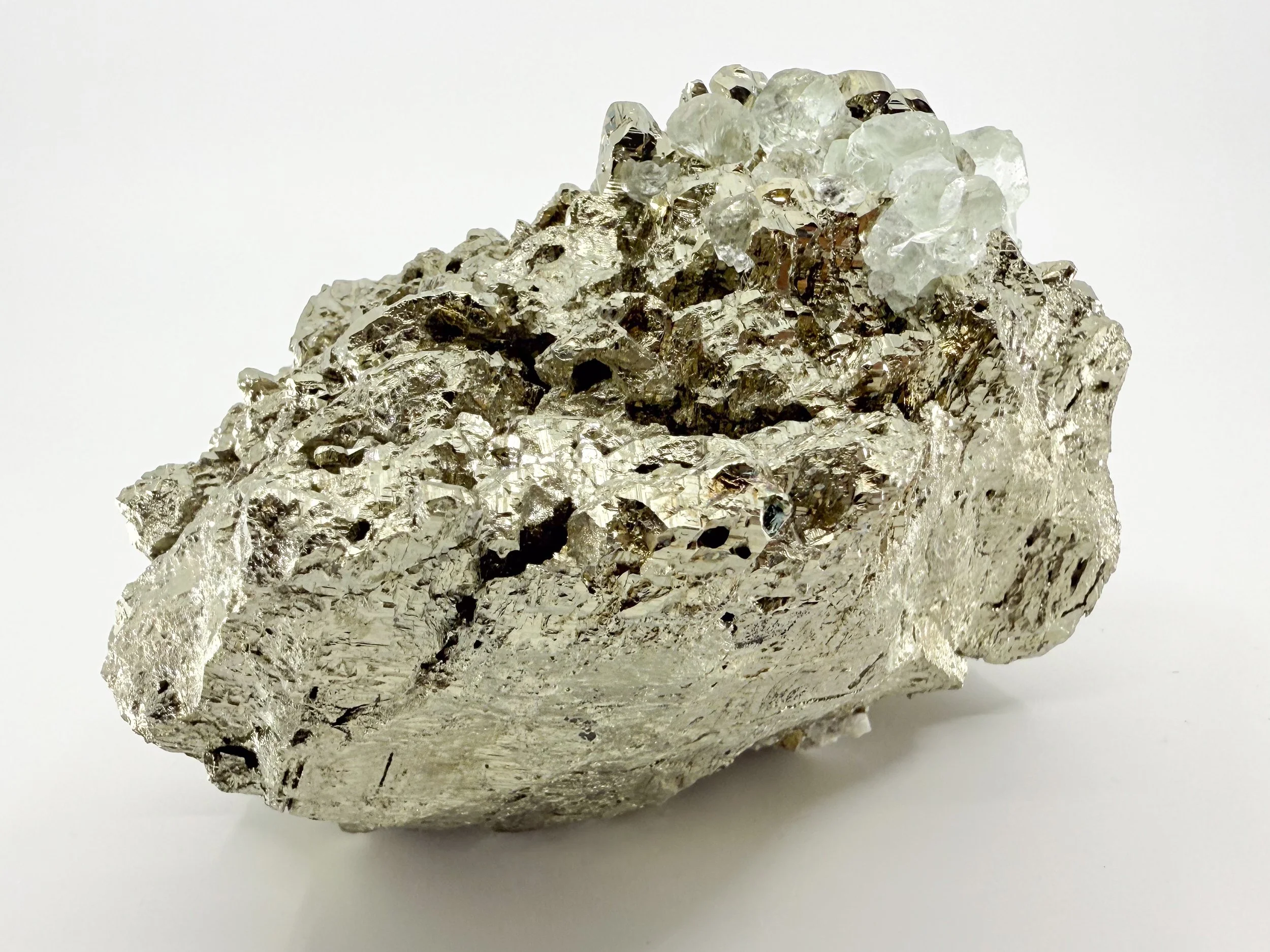


Pyrite with quartz is characterized by metallic, brass-yellow pyrite set against clear to translucent quartz. The contrast between reflective pyrite surfaces and quartz clarity creates a distinct combination of texture and tone.
This composite forms in hydrothermal environments where pyrite (iron sulfide) and quartz (silicon dioxide) crystallize from mineral-rich solutions. Pyrite typically develops in cubic or faceted forms, while quartz forms hexagonal crystals or crystalline matrices.
Pyrite has been used as a source of sulfur for sulfuric acid production and in early ignition systems due to its spark-producing properties, while quartz has been used in electronics, timekeeping devices, and optical and decorative applications.
Sourced from regions including Peru, the United States, and Spain, each specimen varies in crystal size, distribution, and overall structure.
Pyrite with quartz is characterized by metallic, brass-yellow pyrite set against clear to translucent quartz. The contrast between reflective pyrite surfaces and quartz clarity creates a distinct combination of texture and tone.
This composite forms in hydrothermal environments where pyrite (iron sulfide) and quartz (silicon dioxide) crystallize from mineral-rich solutions. Pyrite typically develops in cubic or faceted forms, while quartz forms hexagonal crystals or crystalline matrices.
Pyrite has been used as a source of sulfur for sulfuric acid production and in early ignition systems due to its spark-producing properties, while quartz has been used in electronics, timekeeping devices, and optical and decorative applications.
Sourced from regions including Peru, the United States, and Spain, each specimen varies in crystal size, distribution, and overall structure.